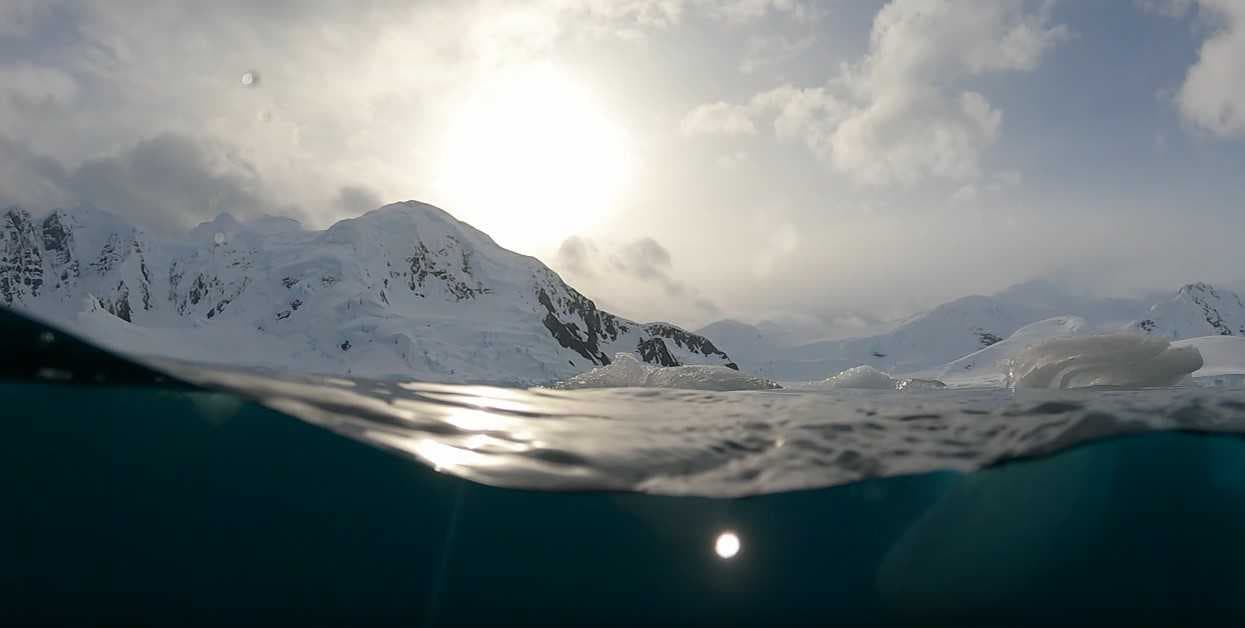
We hear frequently about ice melting near the poles as temperatures have been warming at a faster rate over the past few decades. While glaciers are found all over the planet, there are only two ice sheets.
Ice sheets on Antarctica have melted 140 billions tons per year and nearly twice that in Greenland, according to NASA.
You can think of an ice sheet like a giant ice cube fitting perfectly on top of an island. As the ice cube melts, the ice is pushed closer to the edge of the land before it finally enters the water.
Once that meltwater has actually entered into the water, it doesn't matter whether it is a liquid or if it breaks off into a chunk like an iceberg. It is already submerged in the water which means the water level has already risen.
Whether the ice falls into the arctic ocean or the southern ocean, earth has one contiguous body of salt water that covers three-fourths of Earth's surface.
Sea levels are not uniform across the world. In fact, sea level actually falls near a melting ice sheet due to the reduced gravitational attraction of the ocean towards the ice sheet. At the other end, it rises far from the melting ice sheet.
Fluctuations of sea surface height are normal. However, since the industrial era, the rate of increase has been much faster.
Climate science investigations cite that the rate of rise in the last century was greater than during any preceding century in at least 2,800 years. Research suggests that the rise in sea level increases the frequency and extent of extreme flooding associated with coastal storms, such as hurricanes.
There have been more storms producing locally extreme storm surge and rainfall along the U.S. East and Gulf Coasts over the last 65 years.
Jamie Rhome, deputy director of the National Hurricane Center, says sea level rising affects storm surge.
"It’s not theory; we can measure it. We can see it.”
Rhome explains, “sea level rise provides a higher foundation or a higher base for storm surge to sort of ride on top of it if you will.”
The surge of water that can move inland during tropical systems would be higher and affect communities further inland that may not have been affected in the past.
We may not be able to keep this from happening, but we may be able to slow the rate of melting by adapting to more earth friendly ways. We can lower our risk by using less and cleaner energy such as solar panels.