
The first half of September is historically the peak of the Atlantic hurricane season, but you wouldn't know it by looking across the Atlantic basin this week.
The NBC2 First Alert Hurricane Team is currently tracking three tropical disturbances, but all of those have a low chance to develop into a tropical system.
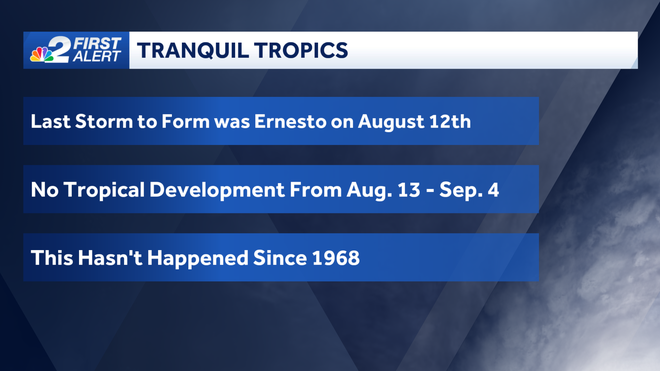
The last storm to form in the Atlantic basin was Ernesto on August 12th.
The last time we've gone without any tropical development from August 13 to September 4 was 1968, which is a pretty staggering statistic for a season thought to bring a potential record-number of storms.
All signs pointed to a very active season in 2024. Record-warm water temperatures combined with a transition to La Niña typically brings busier-than-normal seasons.
But after a very fast start with Hurricane Beryl in late June, which was the earliest category 5 hurricane on record in the Atlantic basin, the tropics have been pretty quiet when we'd typically expect to see things heating up.
Dr. Philip Klotzbach and the team at Colorado State University, known for their pre-season tropical predictions, point to three main factors that have kept the tropics quieter than expected.
The biggest factor appears to be warmer temperatures aloft, which has a stabilizing effect and limits overall thunderstorm activity across the eastern Atlantic.
Second, the train of tropical disturbances over Africa is positioned farther north; these African waves are the seeds that can eventually grow into tropical storms and hurricanes, but since they're moving into the eastern Atlantic at a slightly higher latitude, they're in a much less favorable environment for development.
Third, higher wind shear and drier air seem to be having an impact. Tropical systems need low wind shear and deep tropical moisture to thrive and survive.
It's important to note that just because we've seen this unusual lull in tropical activity, that doesn't mean the tropical tranquility will continue.
Long-range computer models suggest we'll see a pattern more favorable for tropical development in the weeks ahead.
October is also known to be a busy month for south Florida.
While it's unlikely we'll see the twenty or more named storms as initially predicted, this season still has the potential to be a busy one, so it's important to stay updated and prepared.