
Florida's battle with invasive species has taken a new turn, as the population of the non-native brown anole lizard — a key host for disease-carrying mosquitoes — is declining. The invasive lizard, which has been living in Florida for over 100 years, is losing habitat to another invasive species, the Peter's rock agama, according to University of Florida researchers.
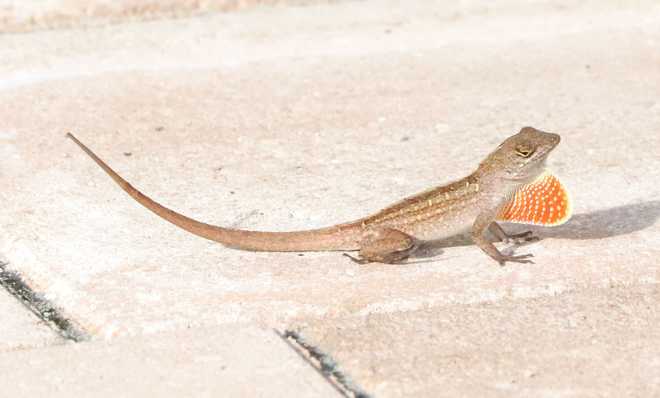
"Mosquitoes love to bite the anole ... because of how they sleep, but agama's aren't ever touched. So what are the mosquitos going to bite? The first target is birds ... but also us," said Lawrence Reeves, an entomologist from the University of Florida.
A team of University of Florida scientists is analyzing the implications of the change in the lizard population and its long-term impacts through a one-year study.
"The hypothesis is that these lizards have been unwittingly protecting us from mosquito-borne viruses, because every mosquito bite that goes to a lizard does not go to a bird; it does not go to a human being," said Nathan Burkett-Cadena, an associate professor of entomology at the University of Florida.
They aim to understand how these invasive species are influencing the spread of mosquito-borne diseases such as West Nile virus, St. Louis encephalitis, dengue fever, and eastern equine encephalitis.
According to the Florida Department of Health, in 2022 (the most recent data available):
- Dengue fever (966)
- West Nile virus (9)
- St. Louis encephalitis (0)
- Eastern equine encephalitis (0)
"I'm stressing that encephalitis word because that is swelling of the brain and it's deadly. This is serious," added Burkett-Cadena.
The study, titled “Invasive lizard-mediated risk of mosquito-borne pathogen transmission,” is one of seven projects funded by a $350,000 grant from UF’s Invasion Science Research Institute.
“This battle over Florida territory by two lizard species may seem minor, given the myriad of problems that Florida faces from other invaders such as Burmese pythons,” said Dr. Burkett-Cadena. “However, this reptile rumpus could have implications for public health.”
Key Focus Areas of the Study
- Examining how the populations of these lizards affect the types of animals bitten by mosquitoes.
- Investigating how changes influence the transmission of mosquito-borne diseases like Avian Malaria, as well as Dengue Fever, West Nile Virus, and others.
- Assessing the broader implications of invasive species on public health.
Florida is particularly vulnerable to nonnative reptiles, with at least 54 species established and breeding in the state, according to UF researchers. The warm climate, major ports of entry, a thriving reptile trade, and destructive storms all contribute to this vulnerability.
"We can't make any conclusions yet ... but we know invasives always have an impact," said Burkett-Cadena.