A new water quality proposal aims to address Marco Island's ongoing issues with impaired waterways while drastically reducing costs compared to previous restoration plans. Last week, Marco Island City Council voted to continue discussions on the idea.
Since 2019, Marco Island has been listed as an "impaired waterway" by the Florida Department of Environmental Protection due to excessive nutrients , particularly nitrogen, which can lead to hypoxia, fish kills, and other impacts on marine life. In 2021, the city of Marco Island hired an environmental firm that suggested various costly strategies to address the issue — efforts that could exceed $180 million. In 2023, Marco Island submitted a water quality restoration plan to the DEP.
Now, a new plan could help Marco Island officials tackle these issues at a fraction of the cost. On Monday, Sept. 23, Dan Davies, a Marco Island resident and owner of Earthwerks Corp , presented a concept called the C-HAWQ (Coastal Habitat and Water Quality Initiative) to city council.
"The plan is to go along and dredge out the contaminated sediment at the bottom of the channels. You've got years when Marco Island used to be on septic systems, you've got all the stormwater runoff," Davies said.
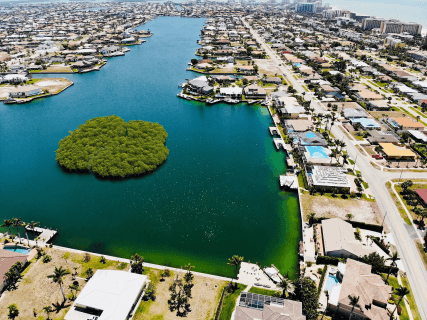
The C-HAWQ proposal envisions a public-private partnership to dredge approximately 1 foot of sediment from local waterways and use it to create approximately 100 acres of small islands, which would naturally filter the water and provide a habitat for native plants and wildlife. The sediment would be reformed into man-made islands using amphibious vehicles and barges, according to the proposal provided to city council.
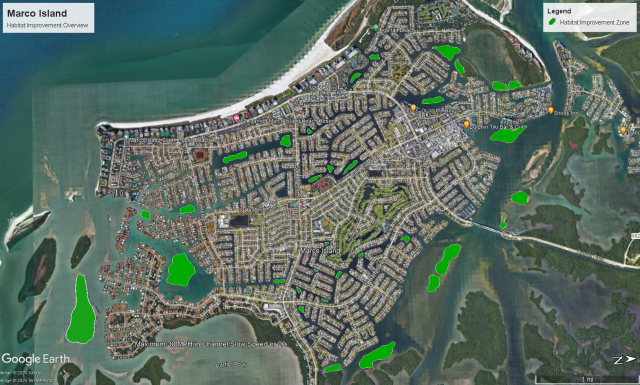
"We then implemented a team so that we can go out and actually pursue the funding for Marco Island. Go to this, look for state grants, look for, you know, places where there's, let's say, bird sanctuary funds or mangrove restoration funds, and then even state legislature trying to get some money appropriated for it," Davies said.
In addition to building man-made islands, the Earthwerks team has brought in local experts in horticulture and conservation at the Naples Botanical Garden .
"They approached us with this idea of creating small islands out of this dredged material. Right off the bat, this is a really fantastic idea because it avoids the impacts of landfilling this ... it benefits the environment. It benefits the economy of Marco Island. It’s a win-win for everybody," said Chad Washburn, the vice president of conservation for Naples Botanical Garden.
The islands will be planted with native species, including mangroves, that can help remove or lock up pollutants in sediments, according to Naples Botanical Garden staff.
"The more plant species that we can get in there, the more function that this will have for the environment, for wildlife, but also to be more resilient and withstand storms in the future," Washburn said.
The expectation is that, if approved, the project to take about two years to complete and would not cause road closures or other issues for residents. Marco Island City Council is expected to discuss this once more at their next meeting on Monday, Oct. 7, at 5:30 p.m.