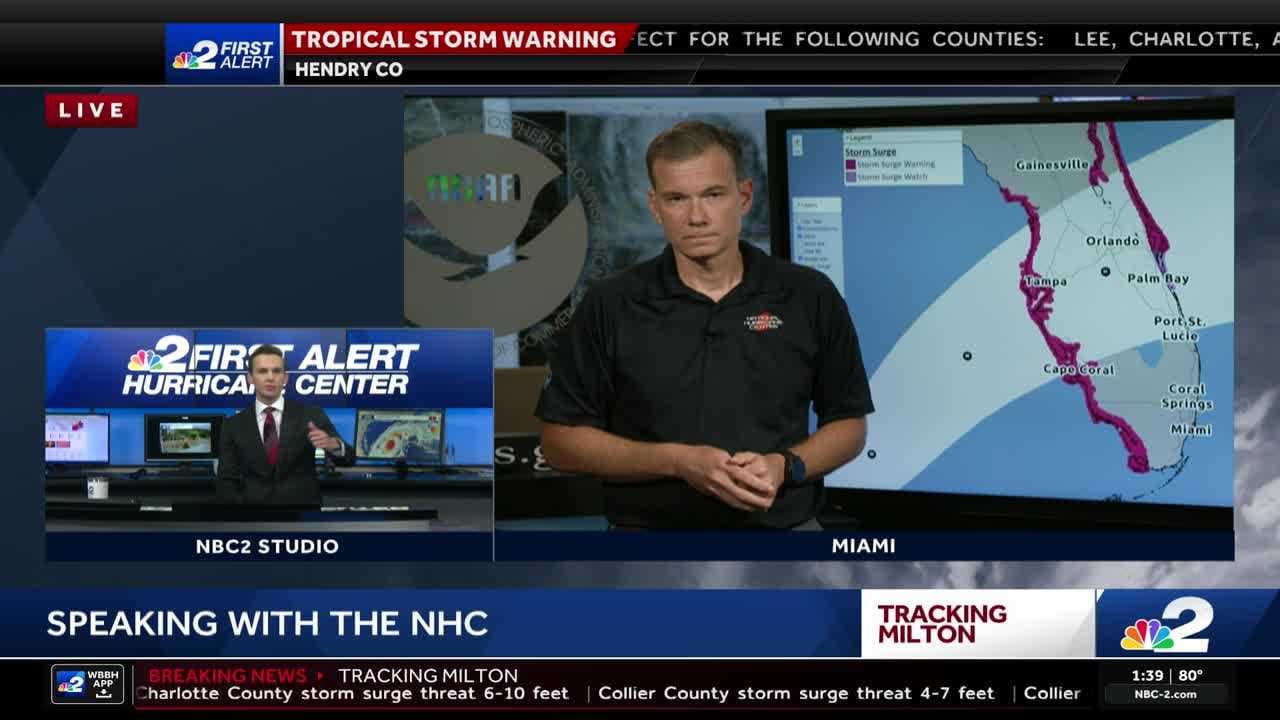
National Hurricane Center Deputy Director Jamie Rhome talks with NBC2 Meteorologist Jason Dunning to explain what you can expect from Hurricane Milton as it approaches Southwest Florida.
Rhome said, "What we’re really talking about is water above the ground level. That’s how far up your leg or your waist the water is going to be — not sea level.”
Rhome explained that the NHC uses high-resolution information to predict how much water will flood certain areas during a storm, stressing that it’s not about elevation alone, but the actual rise of water on land.
In addition to the height of the storm surge, he warned that many people living in elevated homes could find themselves stranded during the storm.
“There will be no emergency access, no 911, no ability to leave your home,” Rhome said. “If you have a medical condition or need assistance, you won’t be able to get help for hours, and that’s when lives are often lost.”
The slow-moving storm is expected to impact the region beginning Wednesday night into Thursday morning, with peak storm surge occurring during high tides. Rhome noted that Southwest Florida could experience two rounds of flooding, one on Wednesday and another late into Thursday morning.
Impact Far Inland
Concerns extend beyond coastal areas, as floodwaters are likely to push far inland. Eeven rivers and tributaries with open access to the ocean could see significant flooding.
“Anywhere there’s a river or water body connected to the ocean, the storm surge will funnel in,” Rhome explained, pointing to the recent flooding in downtown Fort Myers caused by Hurricane Helene, which was 200 miles offshore.
With this storm expected to make a more direct impact, the risk is greater for more widespread and prolonged flooding.
Comparisons to Hurricane Ian Misleading
Some residents have been referencing Hurricane Ian, which struck the area in 2022, to gauge their risk. Rhome cautioned against making such comparisons, as each storm is different.
“A lot of people are saying, ‘I didn’t get storm surge in my yard during Ian, so I’ll be OK with this storm,’ but that kind of reasoning is problematic,” he said. “Storm surge is affected by many factors, including the angle of the storm’s approach, its timing with high tide, the storm's size, and how fast it’s moving.”
Rhome explained that simply comparing storms based on the Saffir-Simpson Hurricane Wind Scale is not enough. “It’s an incomplete analysis,” he said. “I see it time and time again — people trying to do this mental calculation and unfortunately coming up short.”
As Southwest Florida prepares for the storm, Rhome reiterated that each storm is unique and urged people to follow evacuation orders and take necessary precautions to stay safe.
“We want everyone to be prepared and understand the risks,” he said. “Don’t assume you’ll be fine because of past storms. Every situation is different, and the key is to stay informed and take action when necessary.”
