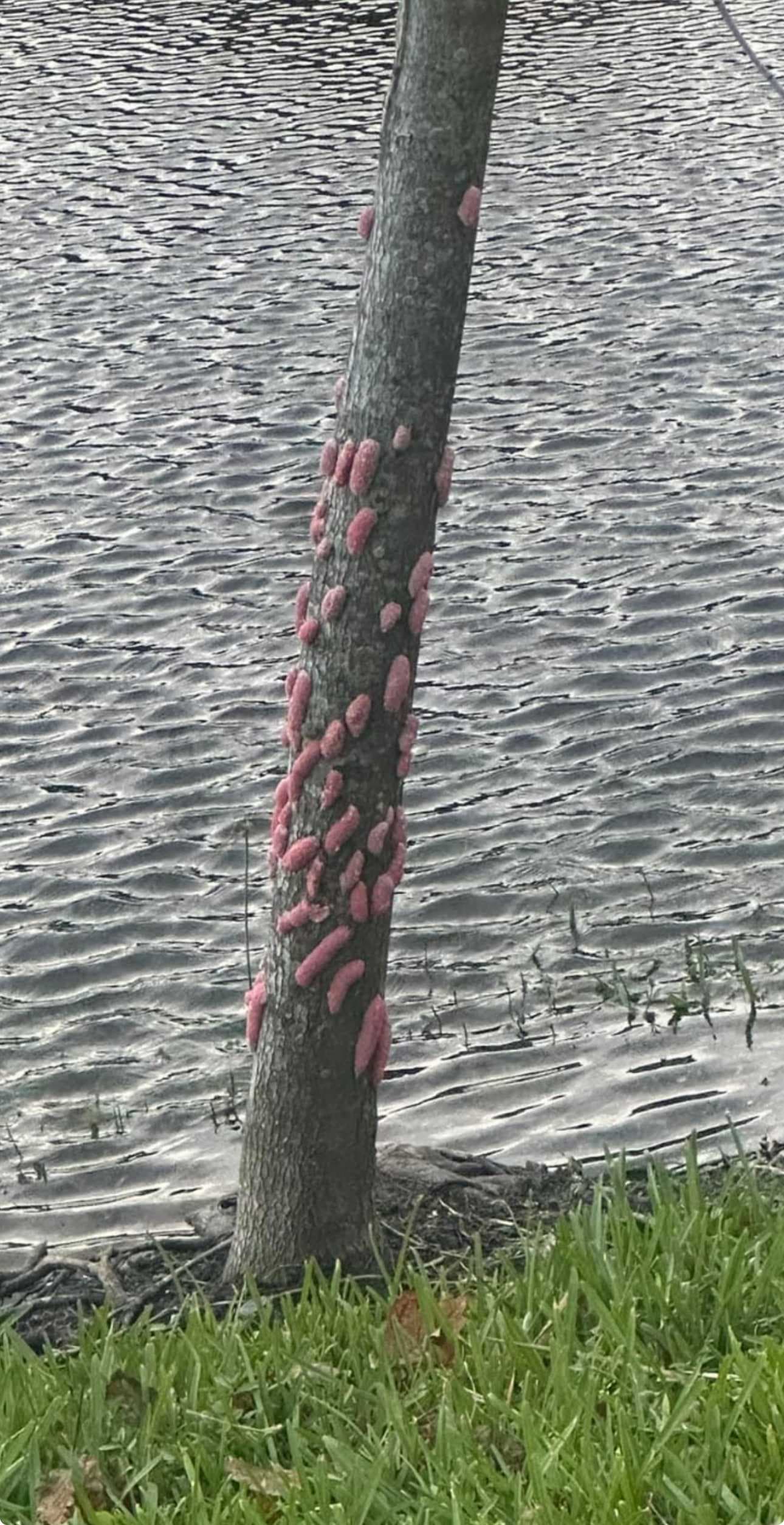
Just in time for Halloween, strange pink globs are appearing on trees and seawalls throughout southwest Cape Coral.
"I’d say they look like cotton candy," said Ryan Klott, who noticed the vibrant clusters at his apartment complex off Chiquita Boulevard after the stormy weather. "I’m not entirely too sure what they are or what they do or where they’re from."
Neighbors living near freshwater canals have also noticed these bubblegum-like formations caked onto dock pilings and stuck in the grass near the water.
"They’re creepy," said Karen Fulton, another southwest Cape resident.
"I just wanna know if they’re dangerous to the dog in case my dog wants to go and sniff around or whatever," said Klott.
If you’ve guessed that these peculiar pink invaders are the eggs of invasive island apple snails, you’re correct! Dr. Christina Anaya, an assistant professor at FGCU specializing in parasites, explains that these eggs can irritate the eyes and skin upon contact. Furthermore, the snails themselves can carry harmful parasites.
"Apple snails, like other, many other species of snails, have the potential to carry a parasite called the rat lungworm," said Anaya. "You don't want your pets to eat them. If you find them in your garden, you want to avoid those fruits and vegetables. Their slime can have some of the parasites in them."
People try to scrape the eggs off surfaces and destroy the clusters, but FWC says right now, there is no practical way to remove the eggs and snails from large areas. Just like a villain in a sci-fi movie, they tend to come back.
"They lay very tiny eggs, so they can lay large collections of eggs of up to 2,000 eggs in one of those little clusters," said Anaya. "So it's not uncommon to see that many, but the, their ability to sexually mature faster and to lay so many eggs allows them to proliferate in the environment. As a result, they can outcompete with our native species."
The good news is the snails and their eggs do have natural predators. Experts say they make a great snack for birds and alligators.
So, as you enjoy the Halloween season, keep an eye out for these peculiar pink invaders and stay informed about their potential impacts on your environment and pets!