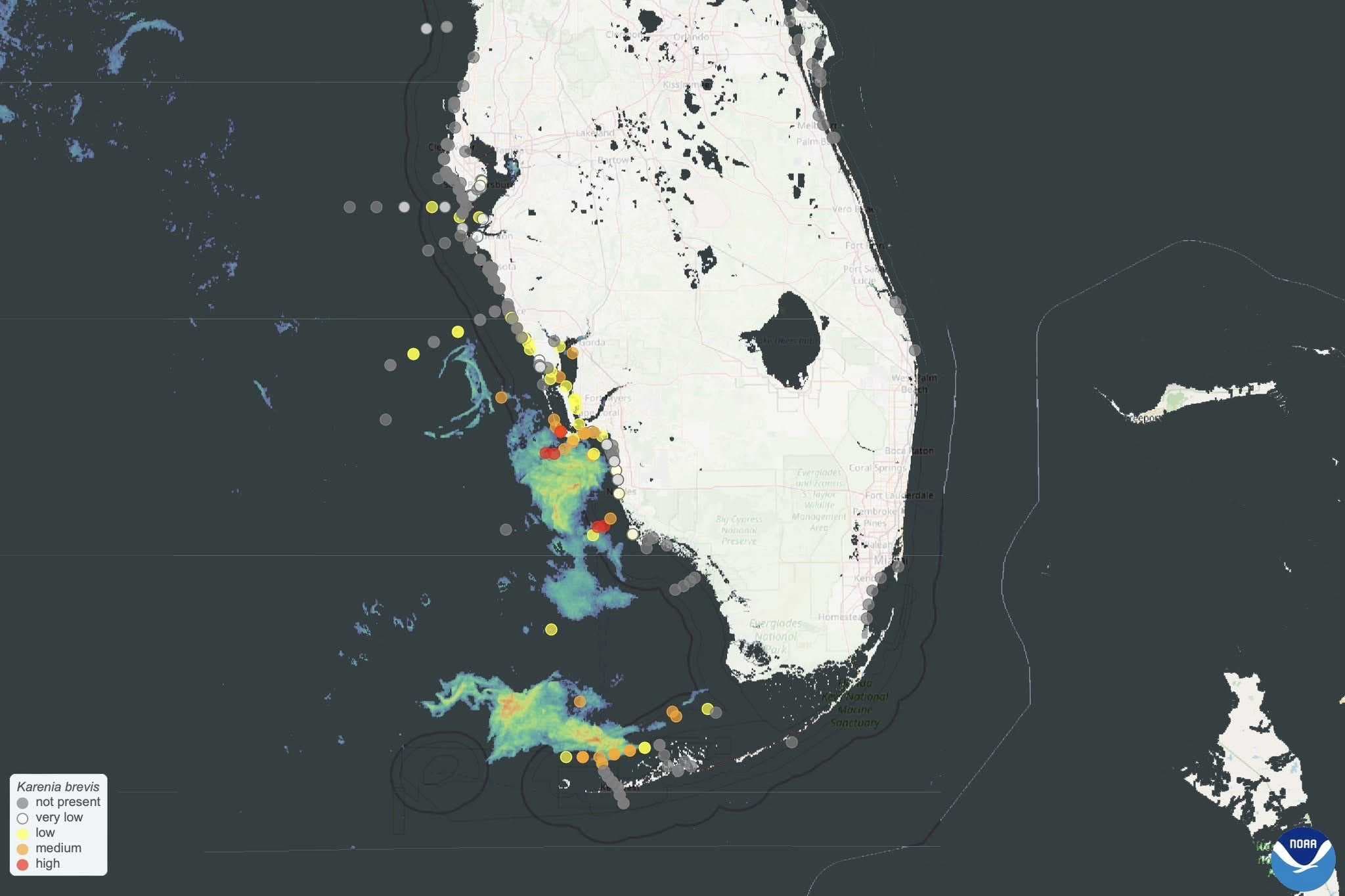
A large-scale red tide bloom that originated in the Tampa Bay area last fall (following hurricanes Milton and Helene) has been slowly moving south, now nearing Southwest Florida’s coast, according to the National Oceanic and Atmospheric Administration. The 100-square-mile bloom has moved from about 20 miles offshore to 10 miles in the past week, with some fragments breaking off and approaching beaches due to onshore winds.
“The bloom started north of here, around Manatee County and Tampa Bay, after Hurricane Idalia. It’s been moving south since then over the last few months ... We noticed at the beginning of January that the bloom has gotten quite large — about 10 miles by 10 miles. Just in the last two weeks, we’ve seen impacts on the beach," said Eric Milbrandt, director of the Marine Laboratory at the Sanibel-Captiva Conservation Foundation.
The Florida Department of Health has issued red tide alerts for the following locations in Lee County:
- Allison Hagerup Beach Park
- Turner Beach
- Bowman’s Beach
- Gulfside City Beach Park
- Tarpon Bay Road Beach
- Lighthouse Beach Park
- Lynn Hall Beach Park
- Bonita Beach Park
- Cayo Costa
- Bokeelia Fishing Pier
- Blind Pass Beach
- Bowditch Park Beach
In Collier County, alerts have been issued for:
- Barefoot Beach (medium levels)
- Vanderbilt Beach (low levels)
“Now we’re starting to see some of the parts of it peeling off and coming to the beach with moderate to high concentrations. ... At this point, the bloom is close to Sanibel," said Milbrandt.
While much of the bloom remains 10 miles offshore, red tide has begun interacting with local beaches. SCCF has observed fish kills along the shores of Sanibel, particularly from Bowman’s Beach to Tarpon Bay.
“We've been getting reports from our fishing guide community for several weeks about this red tide bloom, and we've been keeping tabs on it ... A couple of weeks ago, we were on the water. We wanted to get up in the air to see where it was in relation to Southwest Florida," said Chris Wittman, co-founder of Captains for Clean Water.
As the bloom moves south, experts warn that additional coastal areas could see worsening conditions in the coming days.
“Certainly, the areas south of us will likely see some impacts because of the general movement of waters from north to south,” said Milbrandt.