When a commercial crabber in Lee County got a call from someone claiming to be a detective in northeast Florida – saying he was involved in a crime hundreds of miles away – he thought it was a prank.
It turns out, it wasn’t.
The man was eventually arrested – and the reason why left him stunned.
BODYCAM FOOTAGE SHOWS ARREST: ‘THIS IS NUTS’
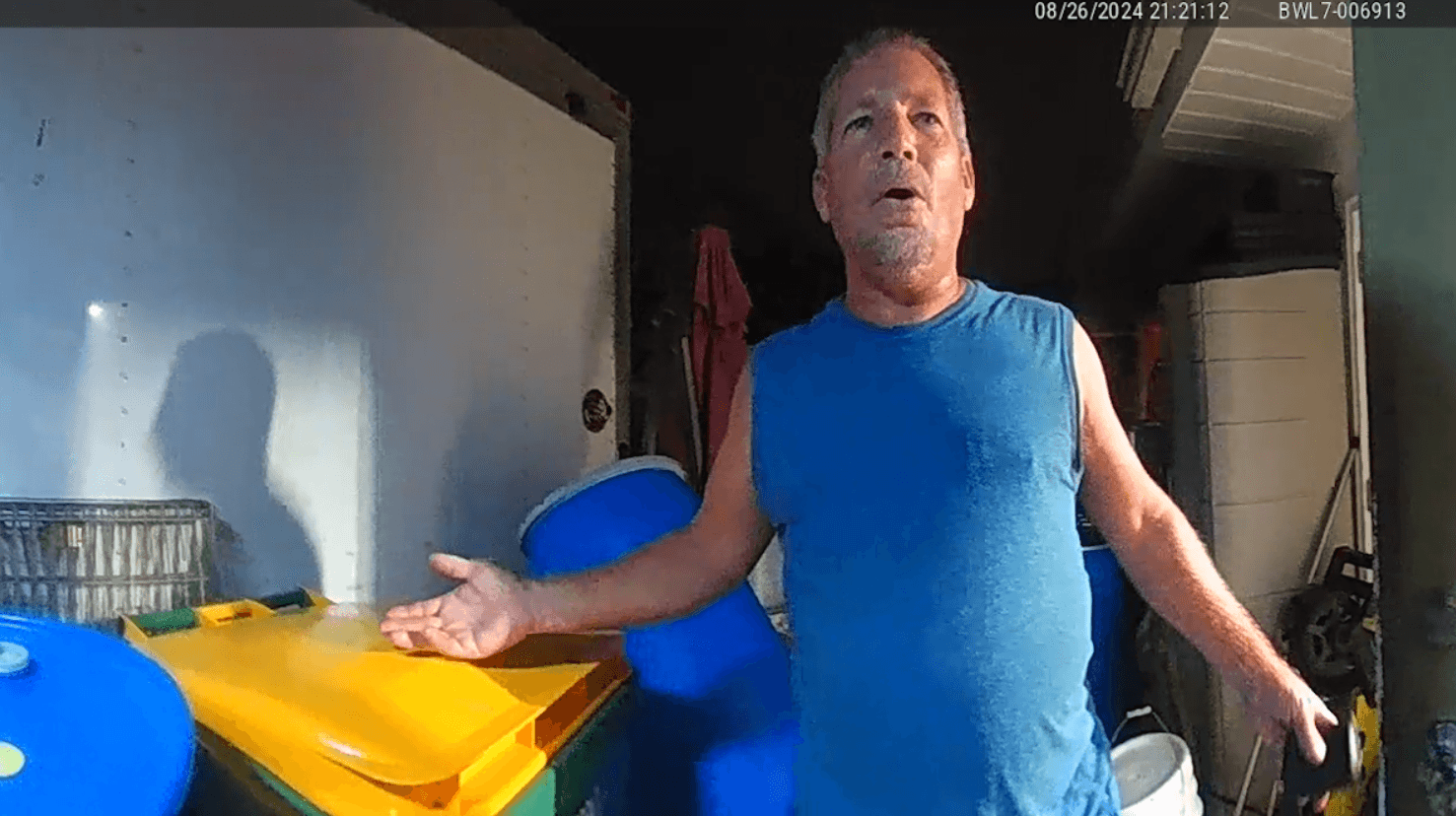
Body camera footage from a Lee County sheriff’s deputy shows the moment officers showed up at Robert Dillon’s door last August.
Dillon looks stunned when the deputy explains he’s there to pick him up on an out-of-county warrant.
“Are you (expletive) me, man?” Dillon asks the deputy when asked to put on shoes.
The exchange is right outside Dillon’s home in San Carlos Park.
"This is crazy,” Dillon is heard saying on the footage.
“What is going on?” his wife asks.
What’s going on – is Dillon is being arrested for a crime he never committed. Despite insisting he’s innocent, he’s handcuffed, put in a police cruiser and taken to jail.
"God, this is nuts,” he tells the deputy.
“I wouldn't know what to tell you,” the deputy responds. “It's not our investigation.”
For Dillon, the only thing harder to believe than the arrest itself would be where the crime happened – and how he was identified as the suspect.
“I'm thinking, 'How in the (expletive) did this happen? How did this happen?” Dillon said in an interview with Gulf Coast News. “They say in life everything happens for a reason. I can't for the life of me figure out this one.”
THE CRIME IN QUESTION: HUNDREDS OF MILES FROM LEE COUNTY
More than 300 miles northeast of Lee County sits the coastal resort city of Jacksonville Beach.
It’s at a fast-food restaurant near the ocean where the crime happened.
In November 2023, a young girl told police that a man – a stranger – had asked her to come with him – twice – while in the restaurant.
Thankfully, she didn’t, and the suspect left. But police were able to pull surveillance photos of the man, and months later, Robert Dillon would be arrested for the crime: accused of luring or enticing a child.
The problem? Dillon said he’s never been to Jacksonville Beach.
“Just out of the blue. They pick some guy that lives six and a half hours away and says, 'This is you.' It blew my mind,” Dillon said.
FACIAL RECOGNITION PROGRAM LEADS DETECTIVES TO DILLON
Reports from the Jacksonville Beach Police Department show detectives initially didn’t have much to go on.
That is – until the neighboring Jacksonville Sheriff’s Office ran the restaurant surveillance photos through a facial recognition program – artificial intelligence – which revealed a 93% match on facial features to Dillon.
The report doesn’t indicate what photo of Dillon sparked the match – whether it was a driver’s license, a mugshot or something else.
He does have a small criminal record, including an arrest for DUI and for a bar fight, but no crimes involving kids.
“I cannot stand any adult to harm a child in any kind of way,” Dillon said.
“He's got black wavy hair. I don't have wavy hair,” Dillon added, looking at the surveillance photos. “He's got a big hole underneath his eye. I don't have that.”
“Says it's 93% accurate. Far as I'm concerned, it's 100% inaccurate,” Dillon said.
DILLON’S ATTORNEY: ‘IT WAS ABSOLUTELY A WRONGFUL ARREST’
Defense attorney Brian Crick, who’s with Jacksonville-based Lockett Law, took on Dillon’s case.
He believes Dillon never should have been arrested for the crime.
“I don't. No,” Crick said. “It was absolutely a wrongful arrest. It was not Mr. Dillon.”
Crick quickly raised concerns with the police investigation. Reports showed neither of Dillon’s license plates were picked up on readers in Duval County, and there’s no mention of police checking readers in Lee County, where Dillon lives.
There was also no mention in the report if police pulled Dillon’s phone records.
A manager at the restaurant did pick his photo out of a lineup, but the report said that the same witness described the suspect as a “regular customer,” and the photo lineup wasn’t shown to them until two months after the crime.
“The more time that passes, the worse somebody's memory is going to be about a specific event,” Crick said.
There is also no mention in the report that the actual victim herself was provided a photo lineup from police.
Crick believes detectives relied too heavily on the facial recognition program during the investigation.
“In fact, there's really an argument that that is exclusively what they relied on,” he said. “There really wasn't much evidence at all."
“A.I. has become extremely powerful. And part of that is it has become just powerful enough to be extremely dangerous,” Evan Lutz told Gulf Coast News.
Lutz, a cybersecurity expert in Fort Myers, works regularly with artificial intelligence.
“You should not take the output of A.I. as scripture. Ever,” he said. “You always need a person to verify the output of the AI. It is not 100 percent."
STATE ATTORNEY ULTIMATELY DROPS CASE AGAINST DILLON
Crick shared his concerns about the case with the State Attorney’s Office in Jacksonville. He sent text messages showing Dillon had a typical day of work – in Lee County – on the day of the crime. He also sent photos showing differences in Dillon’s appearance from the man in the restaurant.
Ultimately, after reviewing the evidence, the state attorney dropped the case.
“It's certainly great for Mr. Dillon. I think there's still questions as to: how did it even get that far?” Crick said.
Gulf Coast News reached out to the Jacksonville Beach Police Department, but a spokesperson refused to answer questions about their investigation or arrange an interview.
The Jacksonville Sheriff’s Office, which used facial recognition in the case, did answer questions from Gulf Coast News.
A spokesperson said the agency uses two different facial recognition programs.
“JSO understands these programs are an investigative tool that assists with developing a lead,” a spokesperson wrote in an email to Gulf Coast News.
The agency does not keep track of how successful – or unsuccessful – the programs are, but the spokesperson said they have “no concerns” about the accuracy of the technology.
A spokesperson for the state attorney wrote a brief response in an email to Gulf Coast News.
“No charge was filed in Mr. Dillon’s case. After he was arrested, our office conducted additional investigation that led to this decision,” the spokesperson wrote. “The office is taking steps to ensure the arrest is not reflected on his record.”
“I mean, it could happen to anybody, that's kind of the scary thing," Crick said. “Somebody that has some resemblance to you commits a crime and they use the facial recognition software, next thing you know – it could be you."
DILLON SEEKING JUSTICE OVER WRONGFUL ARREST
Dillon is now trying to find a civil attorney who can take his case and file a lawsuit on his behalf.
He had to pay to bond out of jail, pay for an attorney to defend him and, ultimately, pay for a crime he never committed.
“I was upset. I was hurt. I just, every emotion you could possibly think, I had it,” Dillon said. “You cannot wrongfully imprison somebody. No matter who you are. Everybody's got rights."