
You'll want to stay up late or wake up early Friday morning, as we'll be treated to a rare sight in the skies over the Gulf Coast: a total lunar eclipse!
During a lunar eclipse, the sun, the Earth and the moon align in that order, with the Earth casting its shadow on the surface of the moon. In a total eclipse, the only sunlight reaching the moon has to pass through the Earth's atmosphere. This scatters out all but the red and orange light, giving the moon's surface a reddish glow. This is why a total lunar eclipse is often referred to as a "blood moon."
The timing of the eclipse will break down as follows:
Moonrise, 7:16 p.m. Thursday
— The full "worm" moon will rise just before sunset.
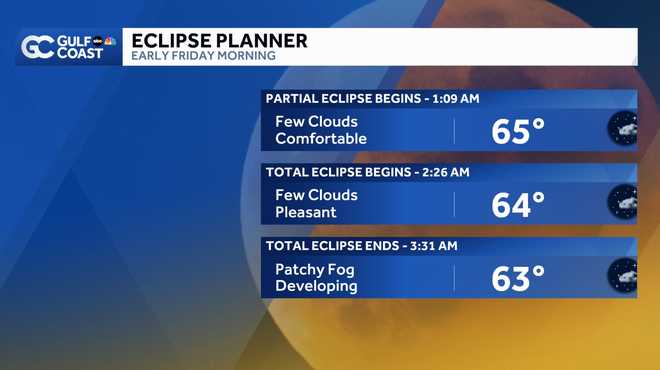
Partial eclipse begins, 1:09 a.m. Friday
— The Earth's shadow will begin to spread over the moon's surface. This is when the Earth's inner shadow or umbra will begin to spread across the surface of the moon.
Total eclipse begins, 2:26 a.m. Friday
— The Earth's shadow covers the moon, which begins to take on a reddish hue.
Total eclipse ends, 3:31 a.m. Friday
—
The moon begins to move out of the Earth's inner shadow.
Partial eclipse ends, 4:47 a.m. Friday
— The moon fully moves out of the Earth's inner shadow.
The weather will generally cooperate with eclipse viewing. It will be mild throughout the night, with temperatures staying in the 60s. No rain is expected, but a weak upper-level disturbance will pivot through northern Florida overnight as well, which will bring in a few clouds at times. Also, with higher humidity, there will be some patchy fog developing, especially north and inland, after 3 a.m. as the eclipse is coming to an end.
Stick with Gulf Coast News as we continue to bring you the latest on the eclipse and the forecast for Thursday night and Friday morning.
DOWNLOAD the free Gulf Coast News app for your latest breaking news and weather alerts.