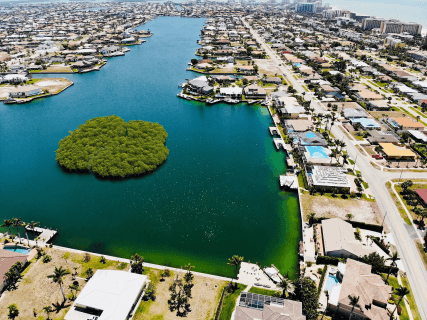
Dozens of small, man-made islands could be the key to fixing Marco Island’s long-standing water quality problems — at no cost to local taxpayers, according to an unsolicited proposal.
Marco Island City Council held a special meeting Monday to review the idea from Marco Island resident Dan Davies, CEO of Earthwerks Corp . His plan, called the Coastal Habitat and Water Quality Initiative (C-HAWQ) , aims to dredge polluted canals and build approximately 27 “mini islands” designed to filter out harmful nutrients.

After about two hours of discussion, the Council voted 4–3 to allow C-HAWQ to fund an environmental feasibility study — estimated to cost around $30,000. The city, not the group, will choose the independent expert conducting the review. It’s the first step in a longer approval process for the concept to move forward.
“These channels essentially become stormwater utilities. That’s what they are. All our stormwater runs into those canals. These islands are actually going to continue to maintain the clarity and the cleanness of the water when we’re done. It’s not something you have to do again," Davies said.
Marco Island has been labeled an “impaired waterway” by the Florida Department of Environmental Protection since 2019, largely due to high levels of nitrogen. Those nutrients fuel algae blooms and hypoxia, which can kill fish and damage ecosystems.
The C-HAWQ proposal would use mangroves, oyster reefs, and seagrass to naturally remove pollutants, functioning like massive biofilters.
“They’re just like big filters that you would have in an aquarium or in your pool. You're actually creating a system that uses nature’s superpowers to help clean the water," said Johanthan Koepke, environmental design lead for C-HAWQ.
A previous attempt in 2021 to address the issue was shelved after consultants projected a $180 million price tag. By contrast, the C-HAWQ proposal estimates a $60 million total — entirely covered by state and federal water quality grants.
The city attorney says several steps are still required: completion of the feasibility study, a City Council review, public hearings, and a final agreement if the plan is deemed beneficial.
“We’ve provided a natural-based solution to a human-caused problem,” Davies said.