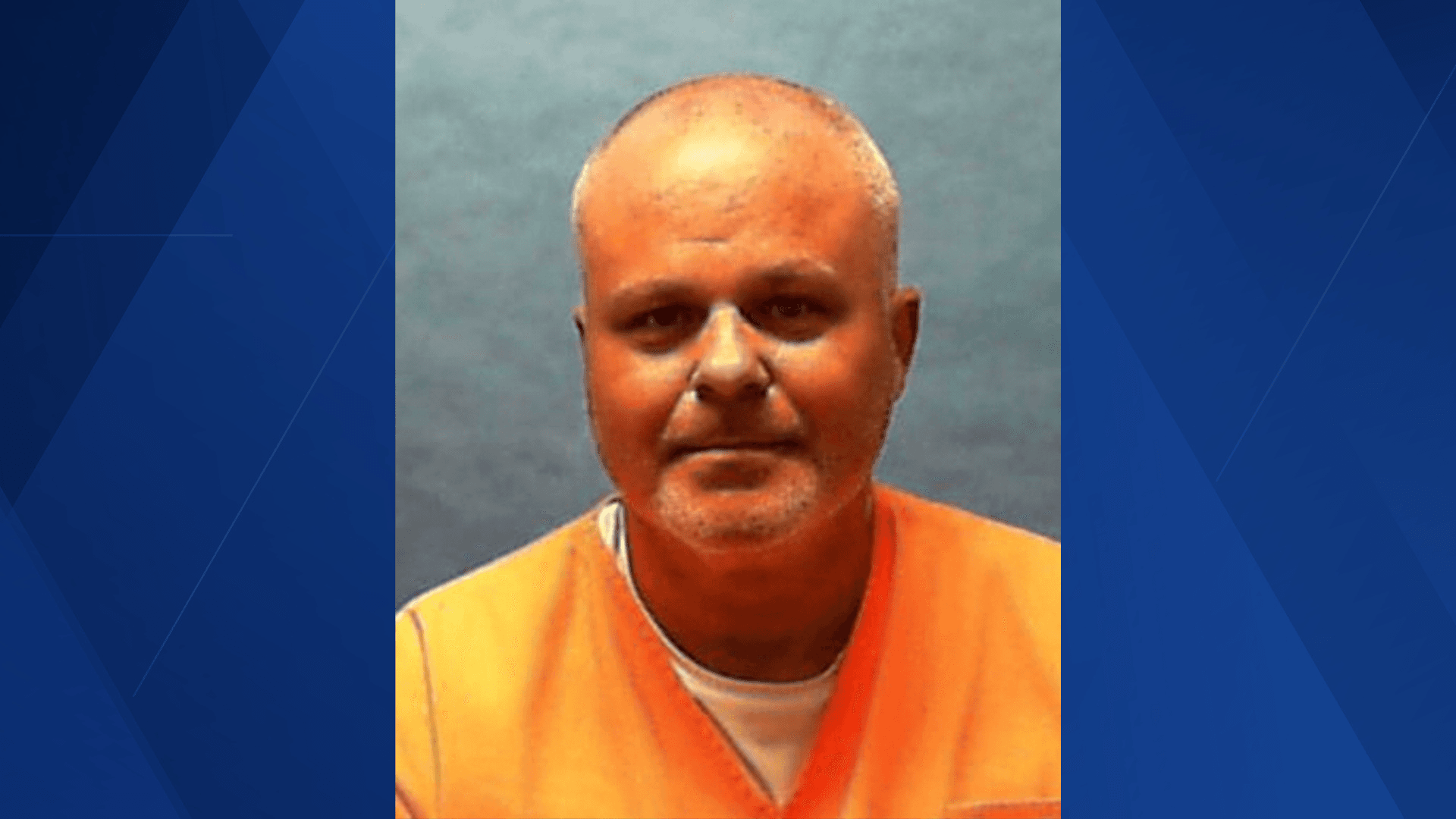
More than three decades after he and another escaped prisoner kidnapped a woman outside a Lake City supermarket and murdered her in a rural area, Anthony Wainwright was executed Tuesday evening at Florida State Prison.
Wainwright, 54, was pronounced dead at 6:22 p.m. He was the sixth inmate put to death by lethal injection this year in Florida. Also, Gov. Ron DeSantis has signed a death warrant for Thomas Gudinas, who is scheduled to be executed June 24 in the 1994 rape and murder of a woman in downtown Orlando.
Family members and other supporters of Wainwright’s victim, Carmen Gayheart, appeared at a news conference after the execution wearing t-shirts that said, “Justice for Carmen Gayheart.”
“I had to be here today to see this through,” said Maria David, Gayheart’s sister.
Gayheart, 23, was a mother of two small children and a nursing student when Wainwright and a co-defendant, Richard Hamilton, kidnapped her as she loaded groceries into her Ford Bronco in a Winn-Dixie supermarket parking lot.
Wainwright and Hamilton had escaped from a North Carolina prison days before the murder. Hamilton forced Gayheart into the Bronco at gunpoint and drove away, with Wainwright following in a Cadillac that the men had stolen in North Carolina, according to court documents. They subsequently ditched the Cadillac and headed north on Interstate 75 before pulling off into a wooded area in Hamilton County, where Gayheart was raped and killed.
“Carmen was a devoted wife, mother, sister, daughter, friend,” David said.
The men were tried together with separate juries in Clay County, after juries could not be seated in Hamilton County. Hamilton, the co-defendant, died in prison.
But David and Gale Gayheart, the victim’s mother-in-law, expressed frustration at the more than three decades for Wainwright’s death sentence to be carried out.
“We are saddened that this … took so long, 31 years for justice to occur,” Gale Gayheart said.
Wainwright made a final statement, but it was inaudible from a viewing room where 27 witnesses, reporters and Department of Corrections officials watched the execution. Wainwright’s spiritual adviser stood in a corner of the execution chamber praying and making signs of the cross during the execution.
Wainwright woke at 3:30 a.m. Tuesday and declined a last meal, Department of Corrections spokesman Ted Veerman said. He was visited by his fiancee, Samantha Hill, and a spiritual adviser in the hours before the execution.
The execution was slightly late starting after the U.S. Supreme Court rejected a final request for a stay. The Supreme Court on Monday rejected two other last-ditch appeals filed by Wainwright’s attorneys. As is common, the court did not explain its decisions, which followed a ruling last week by the Florida Supreme Court that refused to halt the execution
In the appeals, Wainwright’s attorneys argued, in part, that exposure to Agent Orange before birth caused long-lasting cognitive and behavioral problems that need to be considered. That issue stemmed from Wainwright being conceived about six months after his father returned from serving in the Vietnam War and being exposed to the herbicide.
A petition filed at the U.S. Supreme Court said little research had been done at the time Wainwright received his death sentence about transmission of Agent Orange to children and that, if considered, the issue could be a “mitigating” factor that would prevent the execution.
“Here, Mr. Wainwright’s circumstances exemplify the appropriateness of a recognition that the ultimate penalty — that reserved for only the most culpable offenders — would be disproportionate, excessive, and cruel as applied to his individual circumstances. … Although Mr. Wainwright did not serve in the Vietnam War, and was not even a viable life at that point, he was catastrophically and immutably cognitively damaged from it,” the petition said. “Unlike veterans, who make knowing sacrifices for our country in the face of grave risks, Mr. Wainwright had no such choice.”
But the Florida Supreme Court had already rejected arguments about Agent Orange exposure, saying such evidence, if allowed, would not result in Wainwright receiving a life sentence instead of a death sentence.
“First, while Wainwright says he was unaware of the cause of his cognitive and neurobehavioral impairments, his intellectual, behavioral, and psychological issues have been an issue throughout the postconviction proceedings,” last week’s Florida Supreme Court opinion said, referring to earlier appeals after Wainwright was convicted in the murder. “Thus, it is unlikely that one additional cause to explain this set of behaviors would result in a life sentence.”
DOWNLOAD the free Gulf Coast News app for your latest news and alerts on breaking news, weather, sports, entertainment, and more.