Local News
"It's our home again": Family watches replica of lost Fort Myers Beach house rise after Ian
Liz Biro
•1/13/2026
Source: WINK News

FORT MYERS BEACH, Fla. — As a crane lifted her home into the air, Heidi Wright held up her phone, recording every second.
This wasn't just construction. It was the return of her home, a storm-resistant replica of the beach house her family lost when Hurricane Ian tore through Fort Myers Beach more than three years ago.
"It's been a long time coming," Wright said.
The Wright family's original home sat along Estero Boulevard. After Ian, nearly everything was gone.
"After Ian? It was just two and a half pilings," said Heidi’s son, Thom Wright. "Everything was gone — the house was gone, the whole neighborhood was gone."
Thom was 16 years old when his parents first bought the cottage on Fort Myers Beach. Over the years, it became the backdrop for summers, spring breaks, and decades of family memories — packed into just 749 square feet.
"I was down here getting poked by aloe plants and sweating, and it was a lot of fun," Thom said, visibly emotional as he watched the new home take shape. "There were a lot of good memories. I still have those memories. But this is a new beginning, so I'm looking forward to it."
That new beginning looks a lot like the old one.
The Wrights asked Idyll Construction to rebuild a near-identical version of their pre-Ian home — not bigger, not flashier — just stronger.
"We liked it for 42 years the way it was," Heidi said. "So we thought, we'll just do the same thing. Nothing majorly different — except it will be set up much higher."
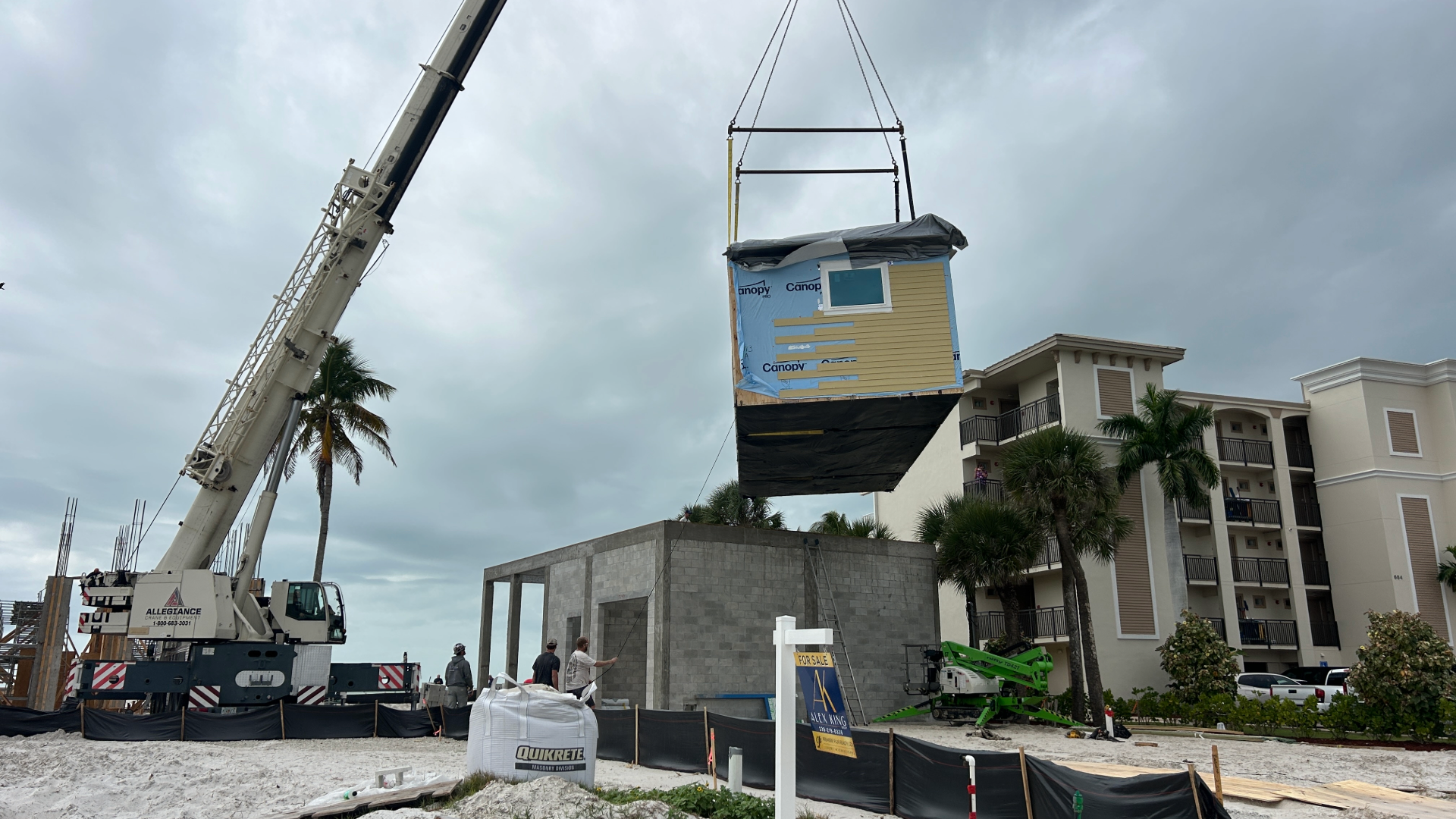
The new two-bedroom, two-bath home is about 800 square feet and now sits nearly 20 feet above sea level, fully permitted for the velocity zone directly on the beach.
It's also modular — built in two sections inside a factory, pre-finished with drywall, paint, cabinets, and countertops before ever arriving on the island. That process cuts months off traditional construction timelines and lowers overall costs.
Mark Raudenbush, president of Idyll Construction, has been building on Fort Myers Beach for more than 30 years. After Hurricane Ian, he says he knew rebuilding the island would require a different approach.
"I drove this beach the first day contractors were allowed back," Raudenbush said. "I looked around and realized we weren't going to be able to make any meaningful change rebuilding the island if we just kept doing things the conventional way."
For Raudenbush, modular construction became part of the solution.
"We're able to bend that cost curve down, get people in at a very attractive price, and get them in a lot sooner," he said.
The homes are designed with deep pilings, concrete grade beams, impact windows, and storm-resistant materials — engineering Raudenbush says can withstand direct hurricane assault.
"They have a backbone and a resiliency of impact windows and storm-resistant materials that's going to make them stand for 100 years," he said.
Raudenbush says the work is personal. He loves the island — and believes rebuilding at a human scale is key to its future.
"The best part of this job is giving families their home back," he said.
For Thom Wright, the best part is simpler.
"I'm looking forward to not having to see and talk to Mark anymore," he joked. "Because that means we're done."
From this point, Idyll Construction says about 60 days of work remain before the Wright family can move in. And later this week, the company will repeat the process — setting another modular home for another longtime Fort Myers Beach resident.

For families determined to stay, and an island determined to come back stronger, it’s another sign of resilience taking shape — one home at a time.
Share: