Local News
Drought puts Peace River fossil hunting on the map with megalodon teeth
Alex Howard
•4/2/2026
Source: Gulf Coast News Now

CHARLOTTE COUNTY, Fla. —

For months, Southwest Florida has been dealing with drought conditions that have been hard to ignore. Massive wildfires have burned through parts of the Everglades and other rural areas, highlighting the challenges dry weather creates for both firefighting efforts and agriculture.
But while drought brings serious concerns, it is also being credited with helping a surprising activity gain traction: fossil hunting.
Lower Peace River Levels
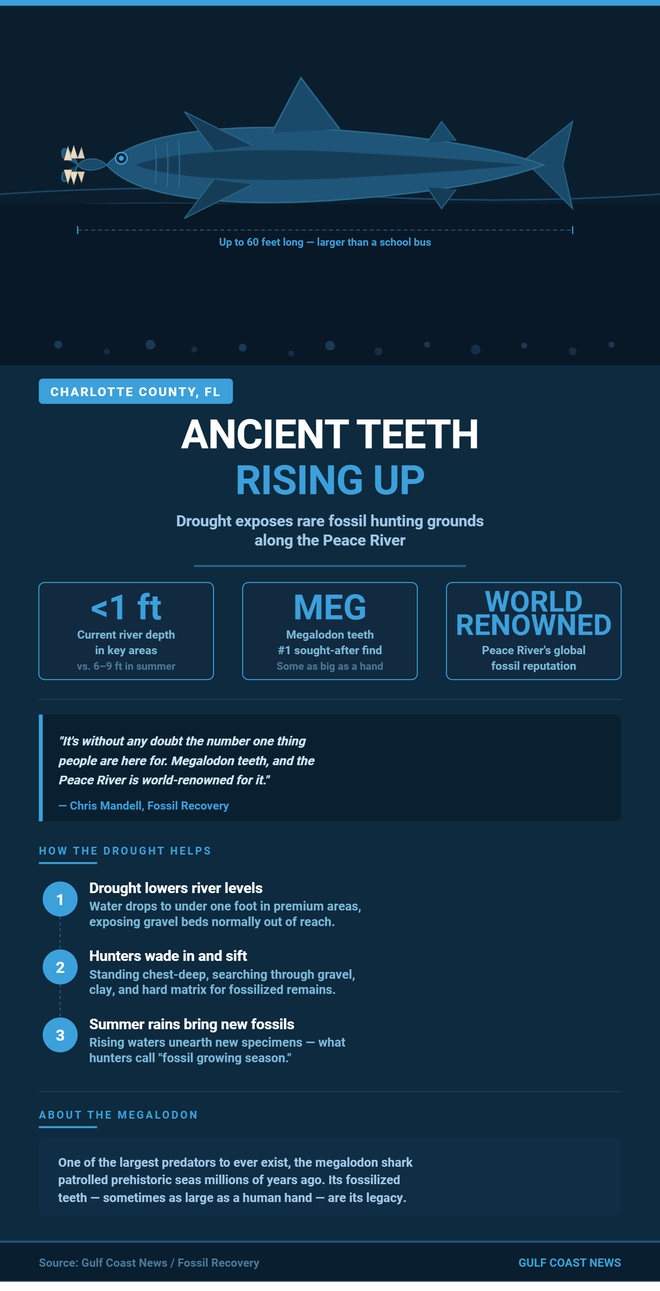
Along the Peace River in Charlotte County, lower water levels are giving fossil hunters rare access to areas that are typically underwater. That means more opportunities to uncover ancient animal remains, including one of the most sought-after finds in the region: megalodon teeth.
“Definitely what we call one of our premium areas,” said Chris Mandell with Fossil Recovery. “That means this is an area where big meg teeth are being found and are continuing to be found.”
When Mandell refers to a “meg,” he is talking about fossilized teeth from the prehistoric megalodon shark, one of the largest predators to ever exist. The Peace River is considered world-renowned for these discoveries.
“It’s without any doubt the number one thing people are here for,” Mandell said. “Megalodon teeth, and the Peace River is world-renowned for it.”
On an average day, fossil hunters can expect to find smaller shark teeth with relative ease. Finding a larger megalodon tooth, sometimes as big as a person’s hand, takes significantly more effort and patience.
Hard Work Required
“It definitely takes work, definitely takes patience,” Mandell said. “Like the big fish, you can’t expect to catch them on one cast, but you certainly can on a good day.”
That work often means standing chest-deep in the river, sifting through gravel and sediment in search of fossils, all while sharing the water with wildlife like alligators.
“Gravel, clay, all kinds of hard matrix, it certainly takes a bit of work,” Mandell said. “Hard work pays. It takes time, and when you really put yourself into it, it really pays off.”
The dry conditions are a key reason why fossil hunting is especially popular this time of year. With water levels at some of their lowest points, areas of the river that are normally inaccessible are now within reach.
If conditions line up just right, fossil hunters can strike it lucky.
“It is a wonderful thing to go in and have that opportunity for our clients to access those fossils that are hard to get to,” Mandell said.
Seasonal Changes Ahead
In fact, some of the spots currently exposed will soon be completely submerged. Within a few months, water levels in parts of the Peace River are expected to rise dramatically.
“The average depth of the Peace River in this area in the summer, after our regular rains or storms, you will see that 6 to 9 feet,” Mandell said. “Right now, for some perspective, we are under a foot deep.”
That seasonal rise does more than just change access. It helps uncover new fossils.
“That’s what we call fossil growing season,” Mandell said. “That’s the best part. When the water comes up, new stuff comes out and grows, like new plants in the spring.”
This natural cycle keeps fossil hunters coming back year after year. Visitors from across the region are drawn to the Peace River for a unique experience.
“It was spring break. We wanted to do something different,” one visitor said. “This little guy loves getting fossils, loves shark teeth. We had heard about the Peace River and wanted to give it a try.”
Still, success is never guaranteed.
“You have to have a really good eye if you want to find good stuff,” Mandell said.
For those willing to put in the time and effort, however, the drought has opened a rare window into Florida’s prehistoric past.
DOWNLOAD the free Gulf Coast News app for your latest news and alerts on breaking news, weather, sports, entertainment, and more on your phone or tablet. And check out the Very Local Gulf Coast app to stream news, entertainment and original programming on your TV.

Share: