Local News
NTSB releases final report on I-75 Naples plane crash
Writer: Nicholas Karsen
•4/23/2026
Source: WINK News

NAPLES, Fla. (WINK) — The National Transportation Safety Board has released its final report on the 2024 Interstate 75 plane crash that occurred near Naples.
The crash, which occurred on February 9, killed two pilots and caused varying injuries to the cabin attendant and two passengers, as well as minorly injuring one person on the ground.
The final crash report states that the probable cause of the crash was corrosion of both engines’ variable-geometry system components, which led to their operation in an off-schedule position and resulted in near-simultaneous sub-idle rotating compressor stalls on approach, subsequent loss of thrust in both engines, and an off-airport landing.

Credit: The National Transportation Safety Board
Further contributing to the crash was inadequate fault-isolation guidance from the engine manufacturer, which prevented the identification of corrosion buildup in the variable-geometry system components during troubleshooting of hung-start events on both engines one month before the incident.
Below is the factual information on the history of the flight and the malfunctions that occurred, leading to the crash.
Crash reports were issued shortly after the crash, which detailed three master warnings recorded, signaling “L ENGINE OIL PRESSURE,” “R ENGINE OIL PRESSURE,” and the final warning, “ENGINE.”

Twenty seconds following the final warning, after 3:10 p.m., and about 1,000 feet above sea level, the crew announced, “—lost both engines—emergency—making an emergency landing.”
The tower controller acknowledged, clearing the airplane to land.
Seconds later, the crew replied, “We are cleared to land, but we are not going to make the runway … we have lost both engines.”
No other transmissions were made, and the ADS-B track data ended just before 3:11 p.m., directly over I-75, near Naples.

Dashcam video obtained by NTSB shows the final moments of the flight. Dropping toward I-75 and aligned with the southbound flow of traffic, the left main landing gear was the first to touch down.
Second was the right main landing gear as the plane kept moving down the interstate before smashing into the concrete sound barrier adjacent to the road.
The cabin and emergency exits were blocked by fire, but the cabin attendant was able to lead a “successful egress of her passengers and herself through the baggage compartment door in the tail section of the airplane.”
The plane stopped about 1,000 feet from where the initial tire marks are on I-75.
Post-impact fire engulfed part of the fuselage. The area surrounding the wreckage was “fuel-soaked” and had a distinct smell similar to Jet-A fuel.
The cockpit center console and the main wreckage were found apart.
The report indicates that both engine throttle levers were discovered in the IDLE stop position.
Also, it was discovered that the flap selector handle was in a position consistent with a 45-degree flap extension. The flap actuator jack screws were similarly found to be consistent with a 45-degree flap extension.
The plane’s left wing was almost completely engulfed by the post-impact fire.
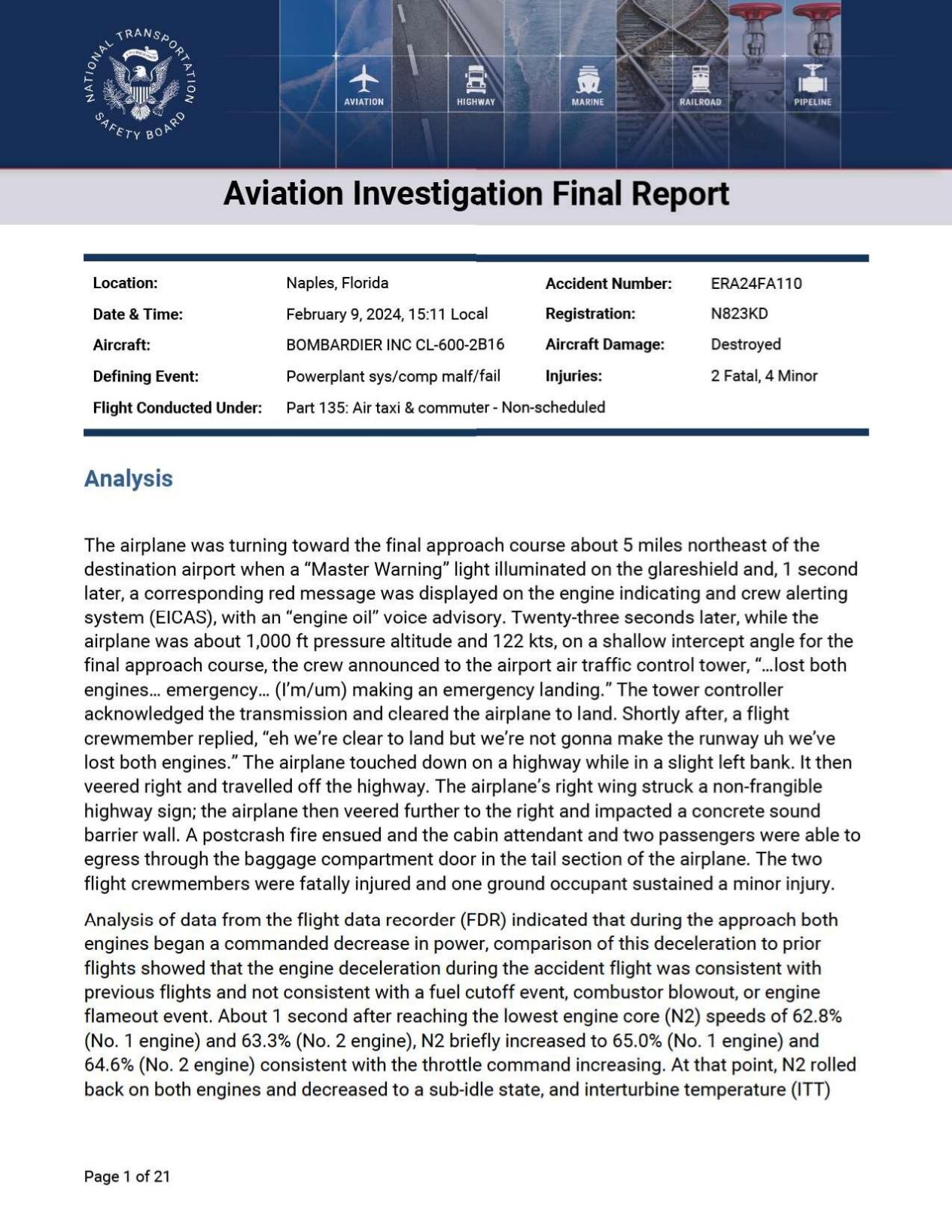
Provided below is the final crash report from the NTSB:
Share: